Publications
Preprints, posters, and talks.
Preprints
- Coming soonAryan Kaul and Brian A. SmithUnder submission
-
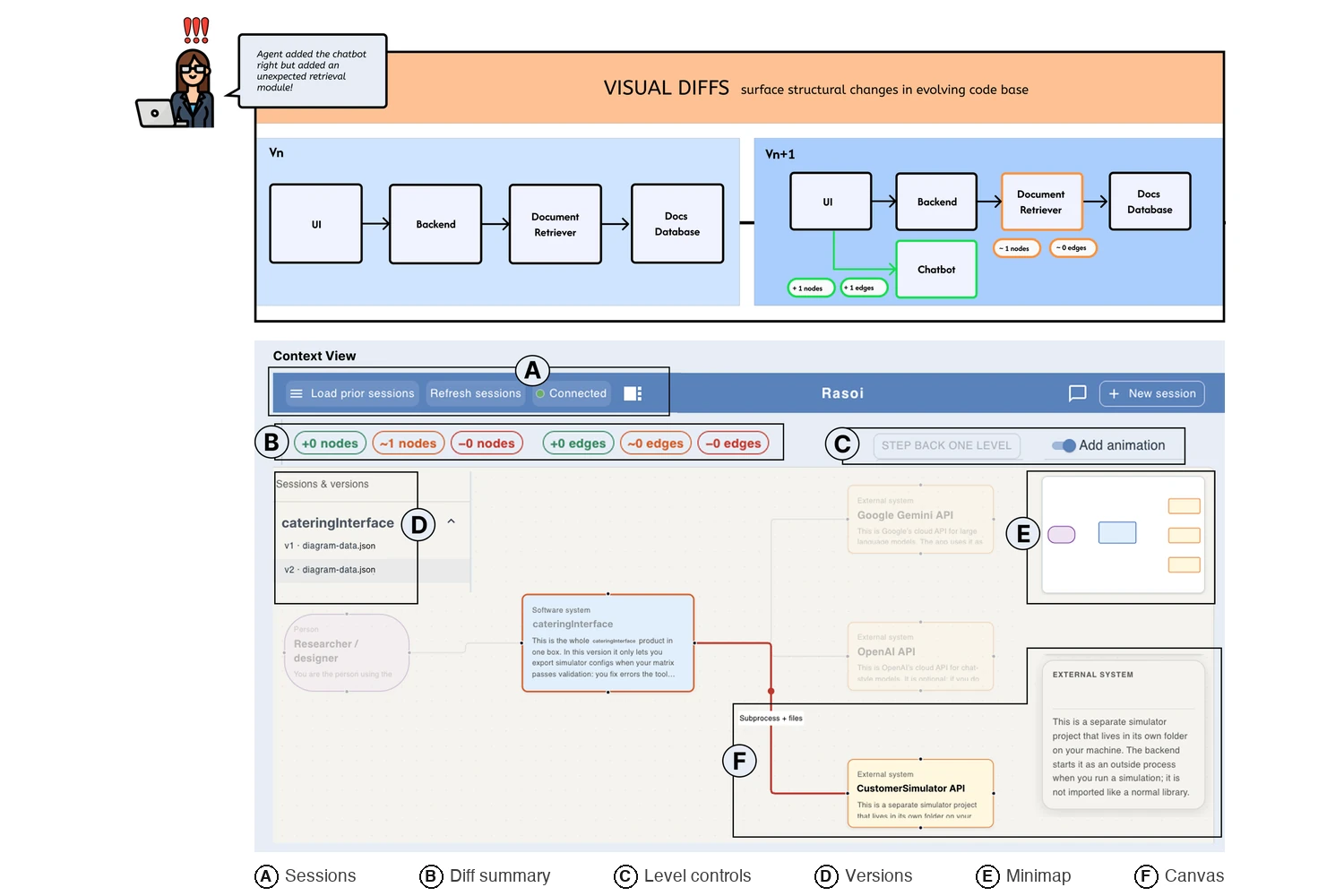 Visual Diffs for Evaluating Structural Changes Made by Coding AgentsRiya Sahni, Aryan Kaul, and Lydia B. ChiltonIn preparation
Coding agents let developers modify software rapidly through natural language. However, as agents take on larger changes, developers can lose track of how the codebase is evolving. These edits may look correct on the surface while restructuring the system in unexpected ways: duplicating logic, changing modules outside the requested scope, removing functionality developers meant to keep, or introducing architectural drift. We investigate how visual diffs can help developers understand and evaluate the structural changes that coding agents make. We present a design probe that maps how a codebase’s architecture evolves after each agent-made edit, letting developers inspect which architectural elements and relationships were added, modified, or removed across multiple levels of abstraction. We deployed it in a week-long study with 12 developers working on their own codebases across varied technical domains. We found that visual diffs helped developers see whether changes stayed within scope, notice unexpected restructuring, and understand how modified parts related to the system as a whole. Our findings suggest that the value of oversight tools for coding agents lies less in making developers trust the agent and more in helping developers feel confident in their own evaluation of agent-made changes. We discuss implications for visual tools that support code comprehension and human oversight in AI-assisted software development.
The paper is complete, pending minor revisions before submission. In the meantime, email aryan.kaul@columbia.edu for a copy.
@misc{kaul2026rasoi, category = {preprint}, title = {Visual Diffs for Evaluating Structural Changes Made by Coding Agents}, author = {Sahni, Riya and Kaul, Aryan and Chilton, Lydia B.}, year = {2026}, note = {In preparation}, pdf_email = {aryan.kaul@columbia.edu}, } -
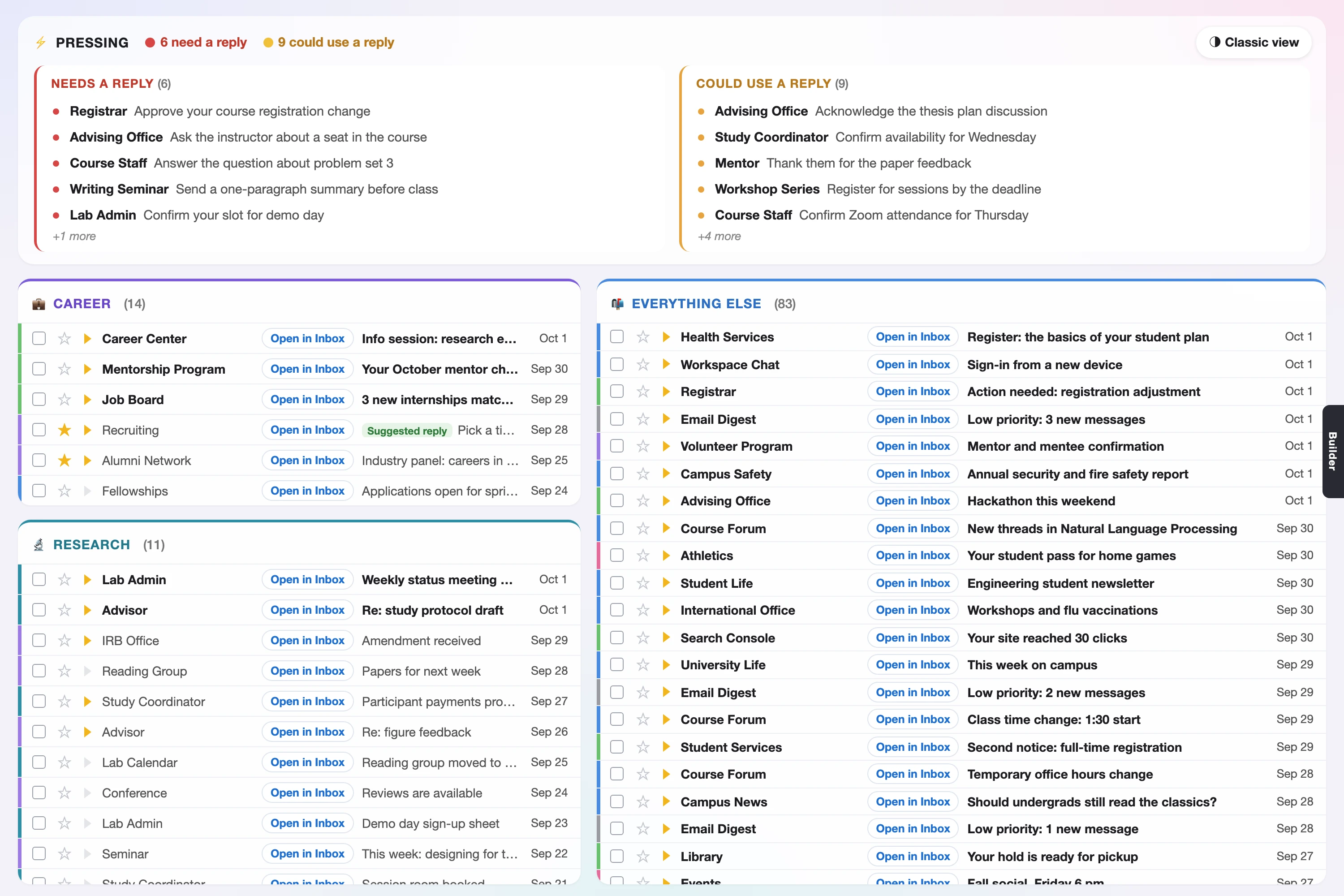 Conversational Customization of Productivity Systems: A Design Probe of Malleable AI InterfacesKarthik Sreedhar, Aryan Kaul, and Lydia B. ChiltonUnder submission
Advances in generative AI make it possible to treat software not as a fixed product, but as a malleable system that users reshape through natural language. Yet end-user customization has historically failed more than succeeded: mechanisms go unused because users never discover them, or sit buried in settings menus offering only the options a designer anticipated. Conversational customization removes these limits, letting users say what they want, when they want it, without engineering skill or the confines of a menu. The question is no longer whether people can reshape their software, but whether they will, and whether customization is still problematic when they do. We investigate this with a design probe, a conversationally malleable email inbox, asking what people customize and why, how their features fare in everyday use, and what risks arise. In a three-day study, eight participants used the probe as their primary email client, creating and refining features for their own workflows. We found that people do customize when the barriers fall: every participant had something to change about their inbox, and customization began with a feeling rather than a feature idea — being overwhelmed by the inbox, resenting repetitive work, fearing a missed deadline. We found that features succeeded not by adding new capability, but by lowering the activation energy of things participants already intended to do. But every feature shipped untested: participants discovered misclassifications, silently hidden information, and unverified automated replies only through use, and these risks divided by whether a feature read information or acted on the user’s behalf. Our study suggests that conversational malleability can dissolve much of the classic barrier to end-user customization. When AI makes software easy to customize, the HCI problem shifts from helping users create functionality to helping them know whether the functionality they created is safe and correct.
@misc{sreedhar2026conversational,
  category = {preprint},
  title = {Conversational Customization of Productivity Systems: A Design Probe of Malleable AI Interfaces},
  author = {Sreedhar, Karthik and Kaul, Aryan and Chilton, Lydia B.},
  year = {2026},
  note = {Under submission},
}
Posters
-
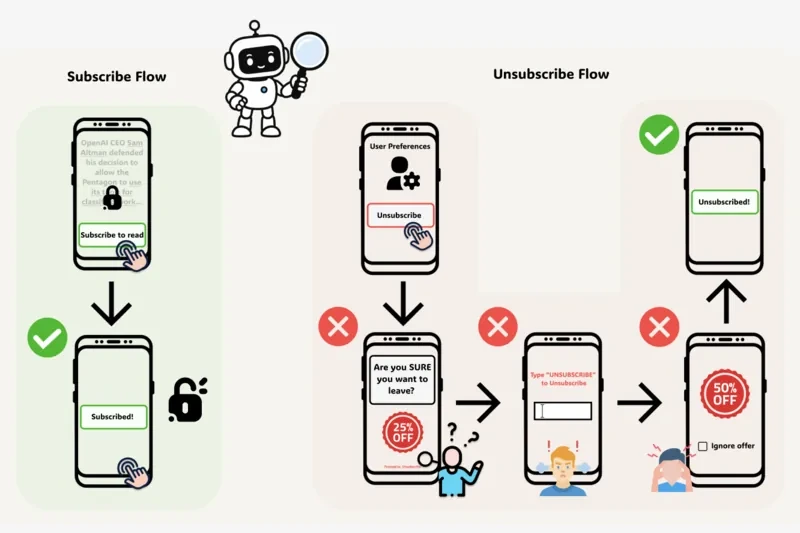 Agents as Auditors: Detecting Malicious UI Flows via Trajectory-Level AnalysisAryan Kaul and Zhuo ZhangIn North East AI Agents Day, 2026
Mobile apps commonly employ dark patterns—manipulative UI designs that steer users toward unintended actions—many of which are invisible on any single screen and emerge only across a sequence of interactions. We observe that a vision-language model (VLM) agent navigating an app produces exactly the interaction trace a flow-level detector needs, and propose "agents as auditors": the agent explores a target app while a multi-stage pipeline analyzes the resulting trace, modeling each interaction as an intent–response sequence and detecting where an app systematically works against user intent. A deterministic rule engine evaluates 31 signals across six rule families (disruptive ads, forced actions, nagging, permission abuse, subscription traps, and system impersonation) over sequences of screens; a trajectory-level reviewer merges compound patterns into a final verdict; and paired subscribe/cancel traces are compared to isolate the roach-motel pattern. Across 32 traces from 20 AndroZoo apps and 10 top-downloaded Google Play apps (over one billion installs combined), trajectory analysis surfaced compound violations that per-screen analysis missed—all 10 Play apps were reported via Google’s potentially-harmful-application channel.
Talks
-
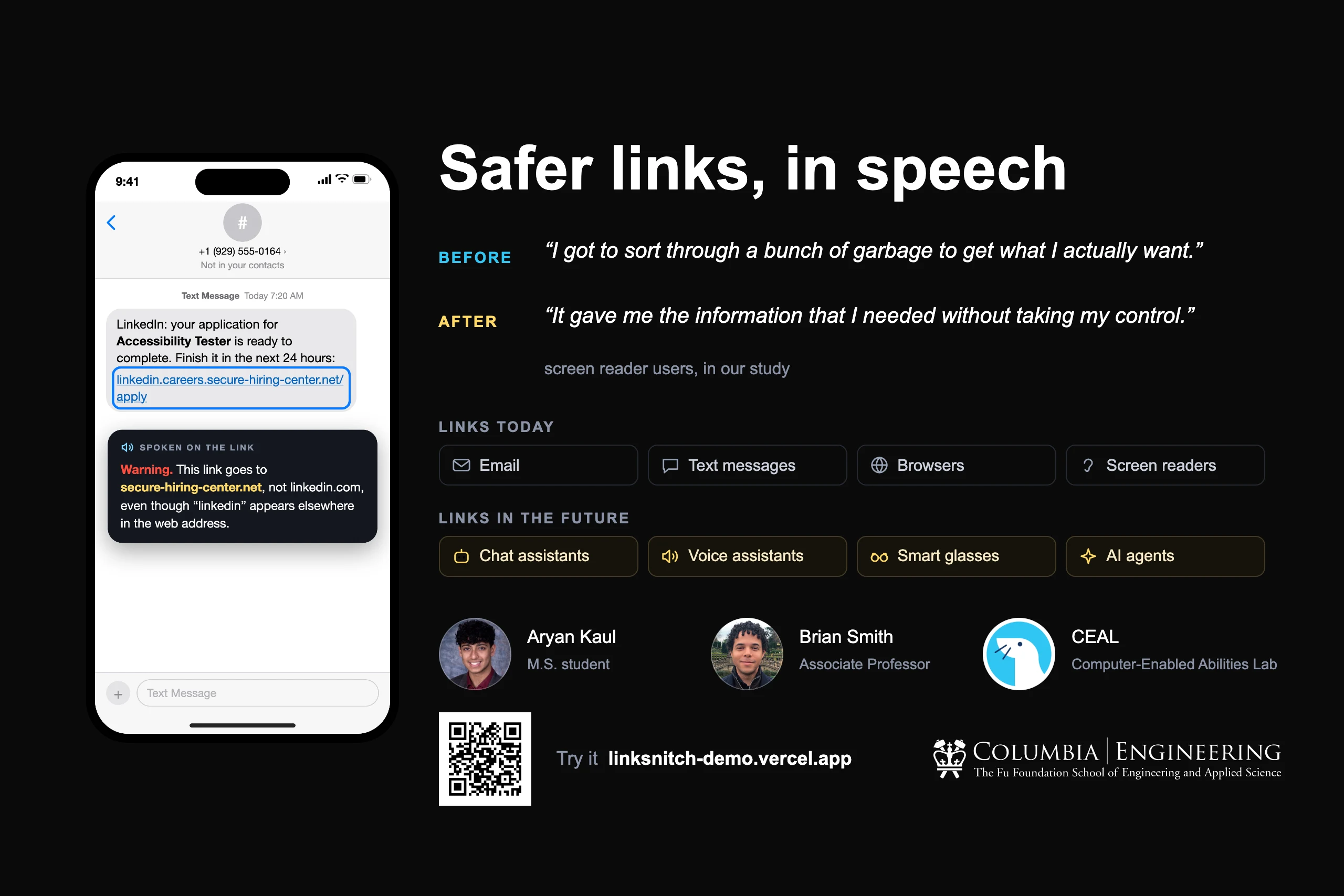 Hearing Where a Link Goes: Safer Links for Speech-First InterfacesAryan KaulIn Cornell AI and Accessibility Summit, 2026
A talk and live demo of a tool that tells screen reader users, in speech, where a link actually goes, so a look-alike address such as linkedin.careers.secure-hiring-center.net is flagged before it is opened. The demo is a working mail, messages, and browser environment seeded with real-world scam patterns. Work in the Computer-Enabled Abilities Lab (CEAL), advised by Prof. Brian A. Smith.
-
 Beyond Code: How Accessibility Transformed My Engineering PerspectiveAryan KaulIn Amazon Global Accessibility Awareness Month (GAAM), 2025
A talk for Amazon’s Global Accessibility Awareness Month on how working on accessibility changed the way I approach engineering, and on using design systems to make accessibility scale across a product instead of fixing it one screen at a time.
-
 Brouwer’s Fixed-Point Theorem and ContinuityAryan Kaul and Vlassis MastrantonisIn University of Maryland Directed Reading Program, 2021
An expository Directed Reading Program talk connecting continuity and fixed points. Starting from low-dimensional intuition, we build toward Brouwer’s fixed-point theorem—every continuous self-map of a closed disk has a fixed point—and discuss why continuity is essential to the result.